As dark clouds rolled in, accompanied by flashes and rumbling, the two-way radio crackled to life: “Storm warning! Expect lightning and high winds. Take appropriate action.” After ensuring the doors were secure and everything was in place, I placed a camp chair on the insulated stool. This was a heavy four-legged stool with insulators on the feet. From this place, I could watch the show unfold around me. The storm quickly surrounded the tower and blocked out the daylight. Such power is overwhelming and awe-inspiring. Blue and white electricity ran 60 feet down the guide wires, over and over, into the ground. I worked four summers on a Fire tower in Southeastern Montana. In that time, I weathered many such storms. I was grateful that the tower was designed to keep me alive.
The tower could do this because it had lightning rods and grounding cables. Instead of the structure taking the hit with the electricity conducted through the lookout, it would strike and be directed harmlessly away. Of course, it was still dangerous. I remember one storm when a strike near the horizon must have hit the phone junction box. The rest of the night, the landline phone would ring with each flash of lightning. I joked to myself, “I’m not answering that! That’s death calling!”
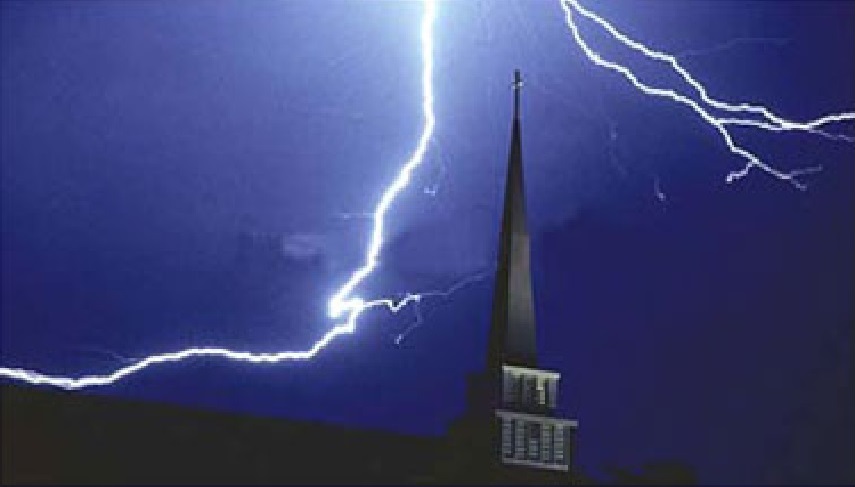
Lightning is powerful, but a rod and wire can direct it and protect structures and people. I remember my mother telling me about door-to-door lightning rod salesmen coming around in her childhood before rural electrification was completed. Lightning rods even saved a lot of churches. Often, the church steeple was the tallest structure in a town, and a lightning rod reduced the amount of damage from strikes.
Your church has a lightning rod you may not even know about. It’s not part of the structure and does nothing to protect the facility. It protects your people from strikes that could do great harm. That lightning rod is you, pastor. Sometimes, we take complaints and attacks to keep them from harming our people. Please understand that I am speaking about small churches whose ministries are primarily volunteer staff. There is an element of this in large churches, but it is more pronounced in small churches.
Attacks, large and small, will come. They will be in the form of complaints, criticisms, and rumors. Many of these will be against you. This is part of the pastoral call. It will happen. But you are not the only one. Leaders, volunteers, and workers will be susceptible to these attacks. While it may also be part of their call, you will often have to protect them—it’s what a shepherd does. To do this, you take the attack head-on and deflect it away. It will hurt, but it is necessary. Let me give some examples.
A few years ago, a woman came to her pastor insisting on leading the women’s ministry. She made a reasonable argument and claimed God was calling her to do this. The pastor was new at the church, so he did not know her well. However, he had some experience with her being overbearing and not faithful at another ministry. The pastor decided to seek advice from some of the older women whom this woman would be leading. The ladies asked—begged—that she not be allowed to lead the ministry. They had known her for decades and agreed she was not the right person for the role. Considering the qualifications for leadership, it was obvious that she would not be offered the position. But should the pastor let her know that her friends of decades did not want her to lead them, or should he keep that to himself? She could be devastated by that knowledge. It would also likely rupture these relationships. But not telling her would make her angry with the pastor—and perhaps the elders. In this case, the pastor served as the lightning rod and took the attack to shield her and the other ladies.
One that is personal to me is music. At one church, a believing brother offered to lead worship. This was a great blessing since we had no one up to that point. Being the late 1990s, canned options were not very good. He did a great job within his limits. His heart was obviously in it. But he did not read music. He could only follow chord charts. As a result, most of the songs chosen were modern “choruses.” Most of the people were accepting and were happy to have worship music. However, there were—and always will be—some who complained. I could have told him that some were complaining. I could have asked him to try to play other music. But I wanted to encourage what he was doing instead of pointing out what he could not do. I told the person it was a blessing to have him playing, and he was using his gifts. I also told the person complaining that they were welcome to offer their own gifts in that service, but otherwise, there would be no change. True, they did not like the answer. True, some left in time. Also true, some of them spoke badly of me in the community, but that was fine. Being ill spoken of is something Jesus promised would happen.
Pastor, there are times we must endure the hurt and harm thrown at our church. People may never know how many such blows we have taken on ourselves. It will seldom be obvious how much damage to the church has been prevented. Those who do know may not understand the value. But it is part of our calling. The shepherd suffers for the sheep. The shepherd surrenders his own comfort to keep the sheep healthy.

 Little Church Big Heart
Leave a comment